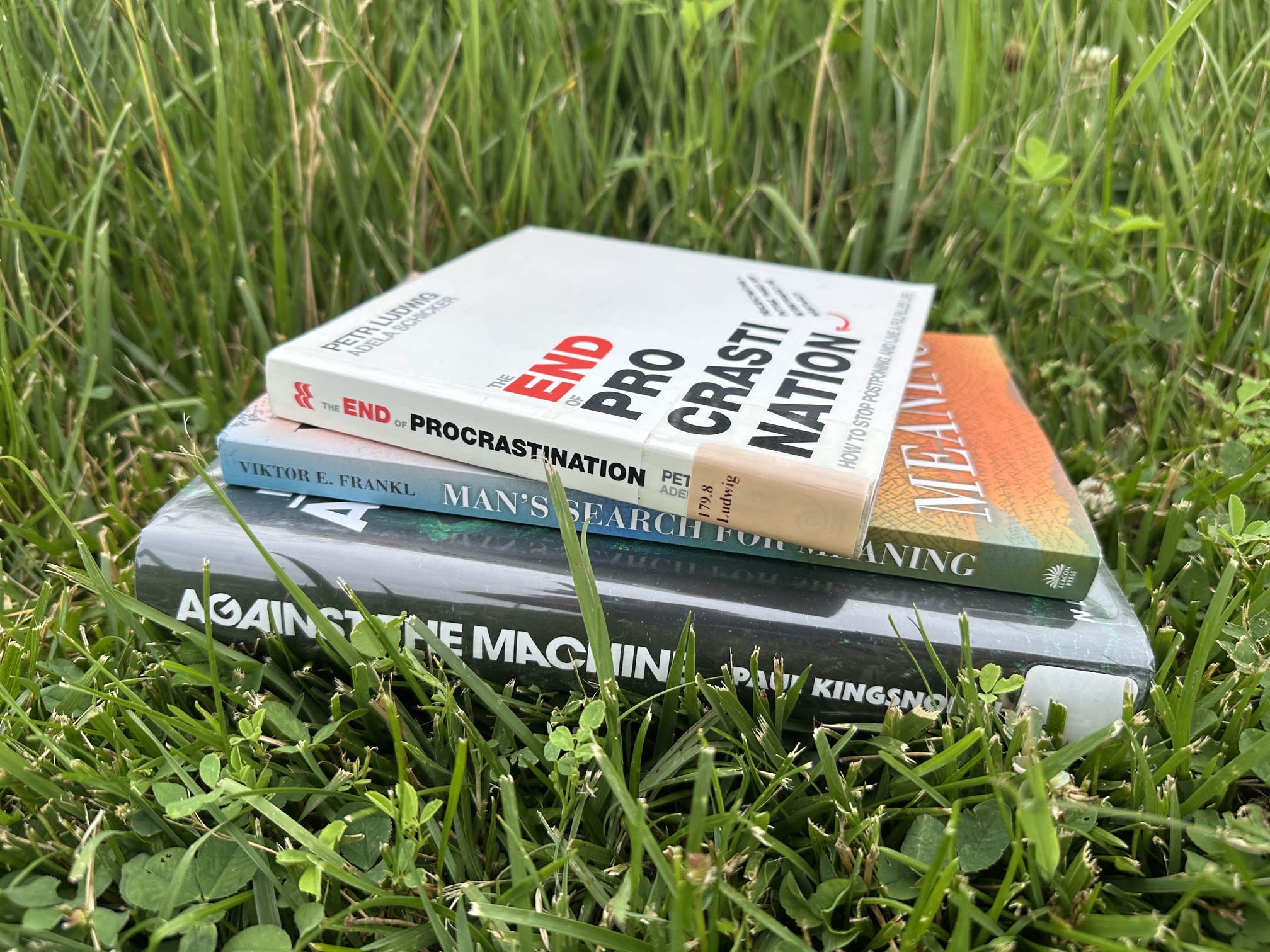
The Emotion of Meaning and Living like a Creature
“It is easy for me to imagine that the next great division in the world will be between people who wish to live like creatures and people who wish to live like machines.” –Wendell Berry (quoted in Against the Machine by Paul Kingsnorth)
I picked up a little book on procrastination at the library this summer with the hope of learning some things that would help my children and me prioritize our time better and make sure we do the things that are really important to us. The End of Procrastination has a serious title, but the design is fun because it is a small, square book with stick figure diagrams to illustrate the main concepts.
Petr Ludwig, the author of this little book, has a lot of great ideas for cultivating self-discipline, and I hope I can follow through with some of them. But my favorite part of this book is his concept of the emotion of meaning.
We all know that intrinsic motivation (working hard because you really want to) is more powerful than extrinsic motivation (working hard because someone else wants you to and is threatening you with either punishments or rewards), but Petr Ludwig explains that some types of intrinsic motivation can be just as harmful to happiness as the carrot and the stick. Intrinsic motivation that is focused entirely on achieving goals can be extremely powerful, but it can also become an odd type of addiction. You don’t need to be super driven to relate to this problem. How many of us have experienced the happiness that results from accomplishing a goal only to replace that old goal a few days later with a more ambitious one? If we are only motivated by achieving goals, we will never be truly satisfied. There will always be new goals to chase.
As an alternative to goal-based intrinsic motivation, Petr Ludwig proposes journey-based motivation guided by a personal vision. Journey-based motivation focuses on the type of person you would like to be and the activities you would like to spend your life doing. We tend to think that what really matters in life are the grand moments and big decisions. In reality, however, life is the sum of small, insignificant moments and the tiny choices we make in each of them.
When those daily, tiny choices contribute to what we believe really matters, we experience what Ludwig calls the emotion of meaning.
Is meaning an emotion? I think it might be bigger than that, but I love this way of putting it. The emotion of meaning is the feeling that your life counts and that your choices can make the world a better place.
Prioritizing the meaning of emotion gets to the heart of living like a human, living like a creature and not a machine.
Paul Kingsnorth has written a whole book about living like a creature called Against the Machine, which I am so excited to read. For now, in this blog post, I want to connect journey-based motivation, the emotion of meaning, and some of the ways I want to live as a creature and not a machine.
Man’s Search for Meaning
In his classic book, Man’s Search for Meaning, psychiatrist Victor Frankl describes his experiences in concentration camps during World War II. The unimaginable suffering of these camps taught Frankl that the one thing people need in order to go on living is meaning.
Frankl writes, “Under the influence of a world which no longer recognized the value of human life and human dignity, which had robbed man of his will and had made him an object to be exterminated (having planned, however, to make full use of him first—to the last ounce of his physical resources)—under this influence the personal ego finally suffered a loss of values. If the man in the concentration camp did not struggle against this in a last effort to save his self-respect, he lost the feeling of being an individual, a being with a mind, with inner freedom and personal value. He thought of himself then as only a part of an enormous mass of people; his existence descended to the level of animal life.” (50)
Frankl observed many prisoners who lost the will to live or became as cruel as the guards in the desperate fight to survive, but others somehow never lost the ability to care for others.
The last of the human freedoms is the ability to choose one’s attitude.
“We who lived in concentration camps can remember the men who walked through the huts comforting others, giving away their last piece of bread. They may have been few and far between, but they offer sufficient proof that everything can be taken from a man but one thing: the last of the human freedoms—to choose one’s attitude in any given set of circumstances, to choose one’s own way.” (66)
Realizing that life expects something from us helps us find meaning.
Frankl recalls helping two suicidal prisoners realize that even though they thought they had nothing more to hope from life, “life was still expecting something from them.” One man had a child who was still alive and the other man was a scientist who had a series of books based on his research that he needed to finish. Only these individuals could answer these calls. Frankl concludes, “This uniqueness and singleness which distinguishes each individual and gives a meaning to his existence has a bearing on creative work as much as it does on human love” (79). What’s amazing is that our uniqueness is meant to show us that life is not just about ourselves.
Living as a creature
I don’t know what God is calling me to now that I have retired from homeschooling, and my children are growing up, but I do know that I want to spend my life doing human things, living as a creature and not as a machine.
- Living as an embodied soul.
- Acknowledging that if I am a creature, I have a Creator.
- Walking with my Creator in faith, trusting him, knowing that he is a good God.
- Trusting that I haven’t been given the birds’ eye view of the future or even the present, but I am like the driver of a car at night on a winding mountain road, seeing only as far ahead as the car’s headlights can illuminate.
- Doing creaturely things. Preparing food. Caring for myself and my family, home, garden, pets, friends, and the people God brings into my life. Valuing process over convenience and productivity.
- Recognizing that even if it is hypothetically possible to fit another activity in the calendar, it might not be a good idea.
- Choosing margin. Accepting limits.
- Making eye contact, smiling, and listening. With my family and with strangers.
- Being grateful. Counting my blessings. Stopping to appreciate beauty.
- Remembering that we are all part of nature.


This is so good!!! Thank you for sharing these beautiful thoughts with the world 🙂 I love how you connect these three (very different!) books all together with your discussion of meaning and living at a creaturely pace. Ooo, and I love the quotes you chose!
Thank you, Nat!!