Lessons for Homeschool Moms from Beowulf
Deadly fights with monsters and dragons, gory details, lavish treasure hoards, legendary weapons, feats of heroic strength, feasting with friends, and luscious wordplay—what’s not to love about Beowulf?
This fall the students in my British literature class read Beowulf and then wrote about life lessons for the 21st century from this thousand-year-old poem. They did a great job, writing about friendship, courage, leadership, and self-sacrifice. I borrowed this assignment from a wonderful website called ELA Brave and True. It turns out there is a whole mini-genre of articles on life lessons from Beowulf on the internet, including “Everything I Need to Know about Teaching I Learned from Beowulf,” lessons in marketing, and lessons in manliness.
This got me thinking: what lessons does Beowulf have for homeschool moms? Certainly we need many of the virtues Beowulf the warrior embodies, including adventure, strength, wisdom, loyalty and the courage to fight for justice, but what can we learn from the women in this poem?
The story of Beowulf takes place in Denmark and Sweden before the Scandinavian invasion of Britain in the 600s, and it was written down by an anonymous Old English poet sometime before the year 1000. As one might expect in an ancient epic centering on the heroic deeds of a warrior and his men, there are not many women in this poem.
Wealhtheow, the queen of the Danes, is one of these few women. The wife of Hrothgar, the Danish king who built a beautiful mead hall that angered the bloodthirsty monster Grendel, she appears in the poem only when the warriors are feasting in the hall. Her job is to offer the shared cup of mead to all of the men. She is “queenly and dignified,” gracious, and generous, always adorned in gold neck bands, crowns, and rings. She speaks carefully and wisely, “with measured words.” She advocates for her sons, reminding her husband to provide for them after his death. She gives gifts of gold to Beowulf and asks him to care for her sons:
Treat my sons
with tender care, be strong and kind.
Here each comrade is true to the other,
loyal to lord, loving in spirit. (1226-1229)
These are good words to live by!
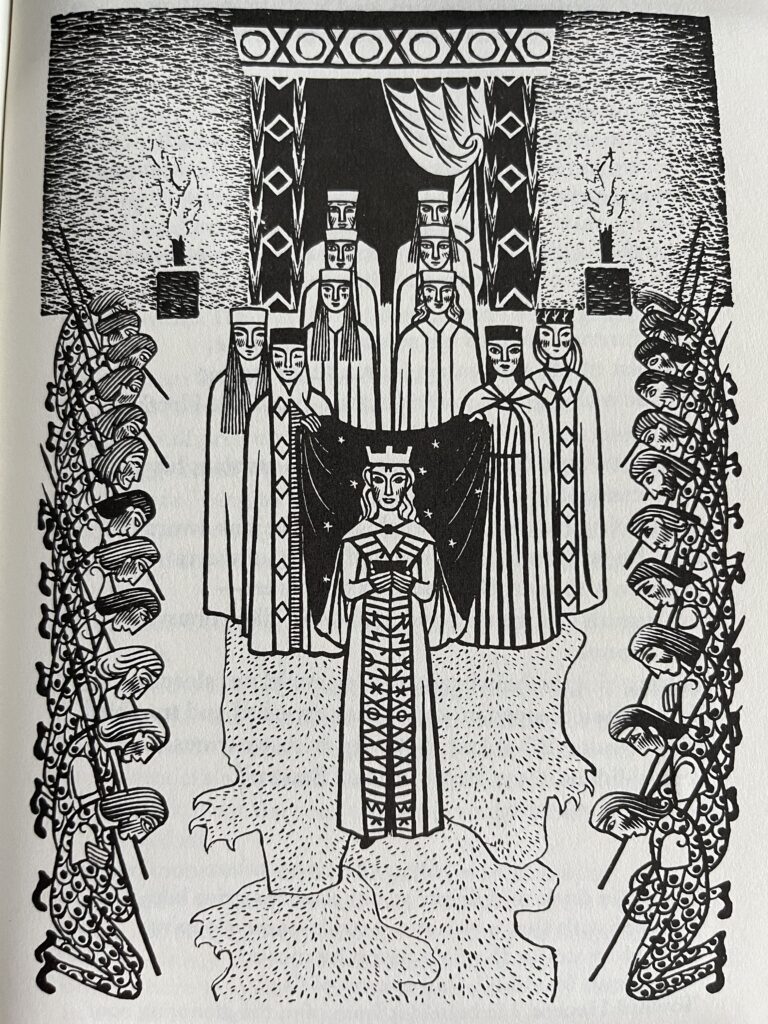
Wealhtheow, along with her Swedish counterpart Queen Hygd, reminds me that I am the queen of my home. I have authority here and need to take responsibility as the leader of my home school. Too often I let life happen to me, instead of intentionally guiding my time, children, and home. A book that I’m reading about leadership called The Failure of Nerve argues that the most important trait of a good leader is their emotional presence—their ability to differentiate themselves from the chaos around them, a quality that I think could also be called emotional maturity. The author explains, “by well-differentiated leader . . . I mean, someone who has clarity about his or her own life goals and, therefore, someone who is less likely to become lost in the anxious emotional processes swirling about. I mean someone who can be separate while sill remaining connected and, therefore, can maintain a modifying, non-anxious, and something challenging presence.” To me, Wealhtheow is a beautiful image of this calm, goal-focused presence in the midst of swirling emotional processes.
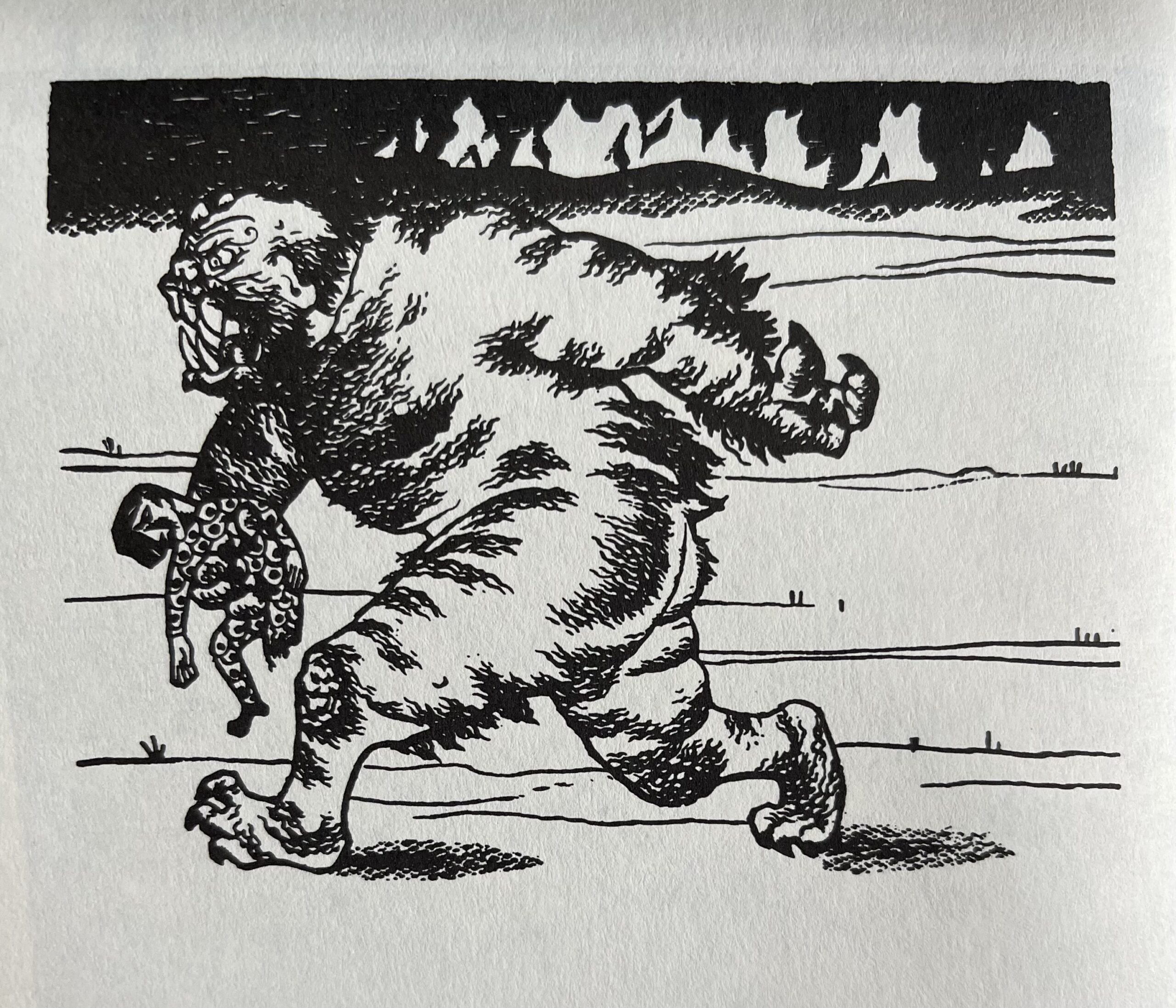
Here is where this essay could get weird because the other important female character in this poem is Grendel’s mother. It’s unclear whether she is human; the country people describe Grendel and his mother as “huge marauders from another world.” Descendants of Cain, “their whole ancestry is hidden in a past of demons and ghosts.” Grendel’s mother lives in a haunted, bottomless mountain lake that is infested with sea-dragons and other reptiles. The poet calls her a “monstrous hell-bride” and “that swamp-thing from hell.”
After Beowulf vanquishes Grendel by tearing off his arm in a wrestling match, Grendel’s mother attacks the mead hall and kills King Hrothgar’s most faithful counselor. Unlike her bloodthirsty son who kills and eats people because he hates joy, Grendel’s mother is motivated by grief for her son and a desire for revenge. She is “grief-racked and ravenous.” Although her son was literally a monster, “she would avenge her only child.” She is horrible, and Beowulf has to fight her for the sake of justice, but we all pity her because of her violent grief for her only child. So, although she is grotesque, Grendel’s mother’s grief is moving to me because it taps into the power of a mother’s love for her child. And this is another lesson from Beowulf for homeschool moms—Grendel’s mother left her watery underground cave out of bereaved love for her child. The love that you have for your child is one of the most powerful things in the world. With great love, a mother can do anything. As Charlotte Mason wrote, “Mothers work wonders once they are convinced that wonders are demanded of them.”