The Book that Helped Me the Most When I Was Considering Homeschooling
Despite the huge growth in homeschooling over the last few decades, something about opting out of school still feels a little bit odd or contrarian. Four years ago, when we were first considering homeschooling,* we were mostly motivated by a practical difficulty with transportation at our current school and a sense of curiosity: would the homeschool life be a fun fit for our family?
At the same time, I kept asking myself, “Why do I want to make my life harder than it has to be?” Our kids were 11, 8, 5, and 3. My boys were still pretty little, and my oldest daughter was just reaching the middle school years. It felt like an intense season of mothering, and I thought that schools were invented to help mothers and fathers. Why wouldn’t I want to avail myself of that help?
So I did what prospective homeschool parents do. I talked to other homeschooling parents and read a bunch of books. Family Matters: Why Homeschooling Makes Sense is the one that helped me the most then and has continued to inspire me.
The opening paragraphs in this wonderful little book were like a lightbulb for me:
“To the oft-cited triumvirate of what is ineluctable in life—birth, death, and taxes—we Americans are prone to add an unspoken fourth: school.
“In fact, we Americans share an allegiance to school that remains for the most part unarticulated. Many of us see schools as the foundation of our meritocracy and the prime prerequisite to a satisfying experience. School is the institution sine qua non, the elemental experience of childhood. Most of us cannot imagine an American youth today without hallways, classrooms, and cafeteria trays; the kind of locker flirtations immortalized in cinema; homework, varsity basketball games, chalkboards, and multiple-choice examinations. School is so deeply ingrained in us that a call for learning outside of it, without it, can sound as strange as a call for us to try to live without food. School is inevitable; school is a fact of life.”
David Guterson, Family Matters, 1.
Oh, that’s so true! And so well put! Maybe that’s why homeschooling still feels a little crazy to me. Just seeing this shared and often unspoken assumption put into words was reassuring to me. The rest of David Guterson’s book is a thoughtful exploration of how learning without school can be a satisfying experience for children and parents and communities.
Family Matters was written in 1992, when there were 300,000 homeschoolers in America. In the past 30 years, homeschooling has grown dramatically. (In 2016, for example, at least 3.3% of American children, or 1.69 million, were being educated at home, and during the pandemic, the number of homeschooling households doubled or even tripled by some estimates.) The number of resources available to homeschoolers has also exponentially increased, but some of the questions about homeschooling have remained the same, and we still have so much to learn from previous generations of home educators.
When he wrote this book, Guterson was a high school English teacher living on Bainbridge Island in Puget Sound and teaching his own children at home. Since then, he has become a well-known novelist, whose most famous novel, Snow Falling on Cedars, was also made into a movie. On his website, Guterson describes this book as “a thorough look at homeschooling as one possibility among many in the education of children. I’m not an advocate. Homeschooling has been exercised to ill effect. At the same time, handled deftly, it’s a rich, fulfilling, and highly successful approach to educating children.”
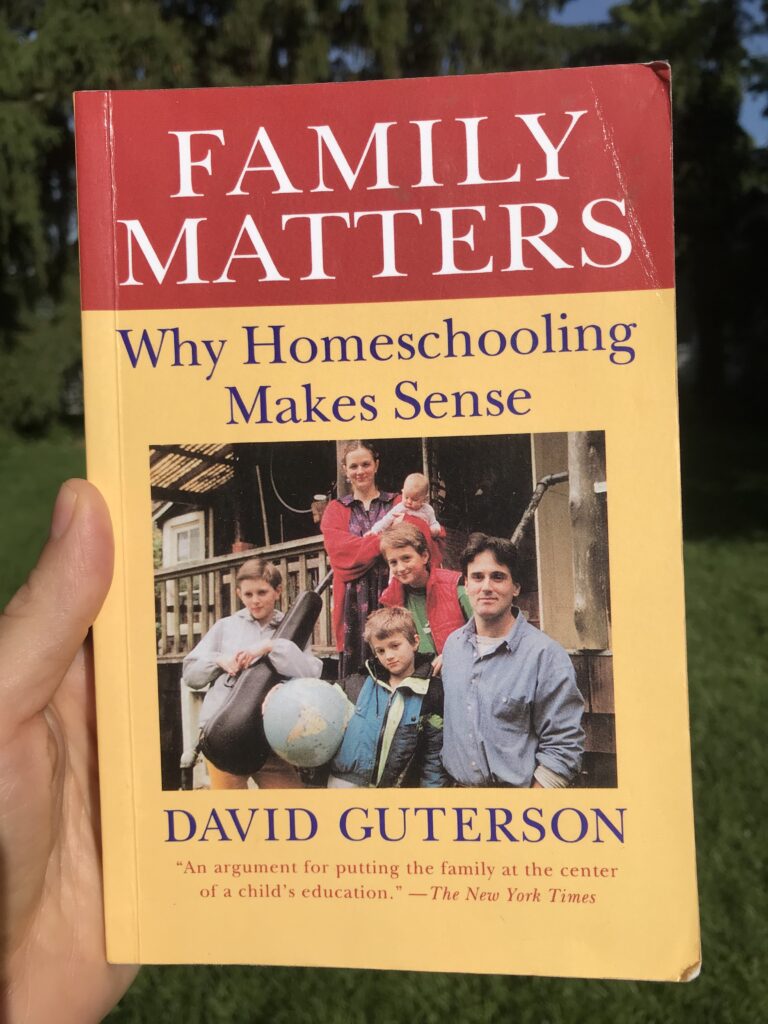
I think that’s one reason why this book is so refreshing. Because Guterson is committed to both public education and home education, he is not trying to tell anyone that they should homeschool or how they should do it. Rather he explains the personal choice that he and his wife made when they decided not to put their son on the bus for kindergarten and considers homeschooling from a number of different angles: the insight and flexibility that parents can use to customize their children’s learning, the ideal of involving all parents more deeply in their children’s education, the question of socialization, the development of homeschooling laws in America, the history of American education, educational philosophies, the necessity of a two-parent income, and the nature of parenting itself.
Guterson’s family represents a secular approach to homeschooling in the tradition of John Holt, the educator and author who developed the idea of unschooling and published Growing Without Schools, the first home education newsletter in America. This approach is also refreshing because, while the majority of homeschoolers in our country are religious, the modern homeschooling movement wasn’t predominantly religious when it began in the 1970s and doesn’t have to be. I love reading about homeschooling from multiple perspectives. There is no one right way to homeschool, and my favorite aspects of the homeschooling community—a willingness to think outside the box and to let children follow their own interests, a delight in family life, and a desire to share what you value most with your children—are shared by religious and secular homeschooling families alike. It’s so freeing to realize that there are many right ways to do something. Sending your children to public or private school or choosing to teach your children at home are all perfectly reasonable choices depending on the unique circumstances of your family, and within homeschooling itself, there are many good options.
Guterson and his wife came to homeschooling almost accidentally. In the spring before their first child was going to attend kindergarten, they became very worried about sending their child to school. They spent the summer reading and talking without coming to a decision about school, but when the first day of school finally came, “the big yellow school bus arrived, waited for a moment with its doors swung open, and our child did not get on it” (8). By the time he wrote this book, Guterson was teaching three of his children at home.
The point of Family Matters is that “parents are critical to education and therefore public educators—and everyone else—can learn much from those who teach their own” (9).
First of all, homeschooling parents have the freedom and insight to customize their children’s education. “Uninhibited by the inherent inertia of schools—their uniformity of content and pedagogy—and intimately connected to their child’s education needs, homeschooling parents are able to invent and reinvent, learn from error, modulate as their understanding deepens, and finally nurture their child’s intellectual growth from the advantageous position of one who loves that child deeply. In short, parents are natural teachers, positioned by the very structure of life to tend to the learning of their children.”
David Guterson, Family Mattters, 22.
Guterson also argues that children do better when their parents are deeply committed to supporting them, no matter the educational context. One answer to improving public schools is to find ways to empower parents to teach their children. A parent doesn’t need to homeschool in order to play a hands-on role in their child’s learning. (It seems obvious to claim that children with supportive, involved parents have a better chance at success as adults, but our current cultural climate often pits public educators against parents.)
In my favorite chapter, “A Life’s Work,” Guterson talks about the satisfaction he feels as a father who is able to be his children’s primary teacher. In his conversations with other parents who are curious about his choice to homeschool, he often feels that fellow parents wish they had the freedom to teach their children; he is “impressed with how deeply the will to teach one’s own is imprinted on the human spirit” (209). According to Guterson, many fathers especially feel cut off from the lives of their children due to the realities of working in a modern world: “they leave in the morning, return at night, and the great chasm between—men report this emptiness—becomes inexorably a part of them” (210).
As a prospective homeschooler, Family Matters introduced me to the reasonableness of homeschooling. I began to dream about all the things I would like to teach my children if we had extra time together at home.
As a current homeschooling mother, I have found that my children love the extra freedom that homeschooling offers. Both my husband and I do have more time with our children because we are able to tweak our schedule to better fit my husband’s work schedule.
As a mother, it is easy to feel overwhelmed with all the tasks I have to do, to let my focus drift away from the wonder of caring for the young humans entrusted to my care and to fix my gaze instead on a child’s temporary poor attitude or the dust on my baseboards. Guterson’s book reminds me of the special gift it is to be a parent who homeschools . . . to let the world be our classroom, to watch my children explore and play, to give them the space to be bored, get creative, and have a less-hurried childhood, to experience the miracle of becoming the fully-orbed people God created them to be.
As Guterson writes so beautifully: “In the end there are reasons beyond education (Can we really detach education from everything else?) to homeschool—a misnomer, in this context, for doing what human beings have always done in bringing up their children. There is a love to be cultivated, an instinct to be nurtured, a need to be satisfied at both ends” (217).
*Actually, homeschooling for the second time. I share a little bit about my first year homeschooling my oldest daughter for kindergarten in this post at Simply Renewed Living.